
01 / Basics
Liquidity is not the same as volume
Liquidity is the ability to buy or sell a meaningful size near the current price. A deep market absorbs an order with little price impact. A thin market moves sharply on the same order.
Market capitalization and 24-hour volume are not liquidity. A contract can print a large daily turnover while the book is thin at the moment you need it.
For a trader, liquidity is a cost and a constraint. It affects the fill you get, the stop you can use and the size you can carry.
02 / Reading
Read depth, spread and slippage
Three readings cover most of the question.
- Depth near the mid priceHow much size is resting within a small distance of the last price? A few large orders can look deep until they are pulled.
- Bid-ask spreadThe gap between the best buy and sell. A wide spread is an immediate cost, even before size is considered.
- Slippage for your sizeThe difference between the price you expect and the average fill you get. It grows with size and with thin books.
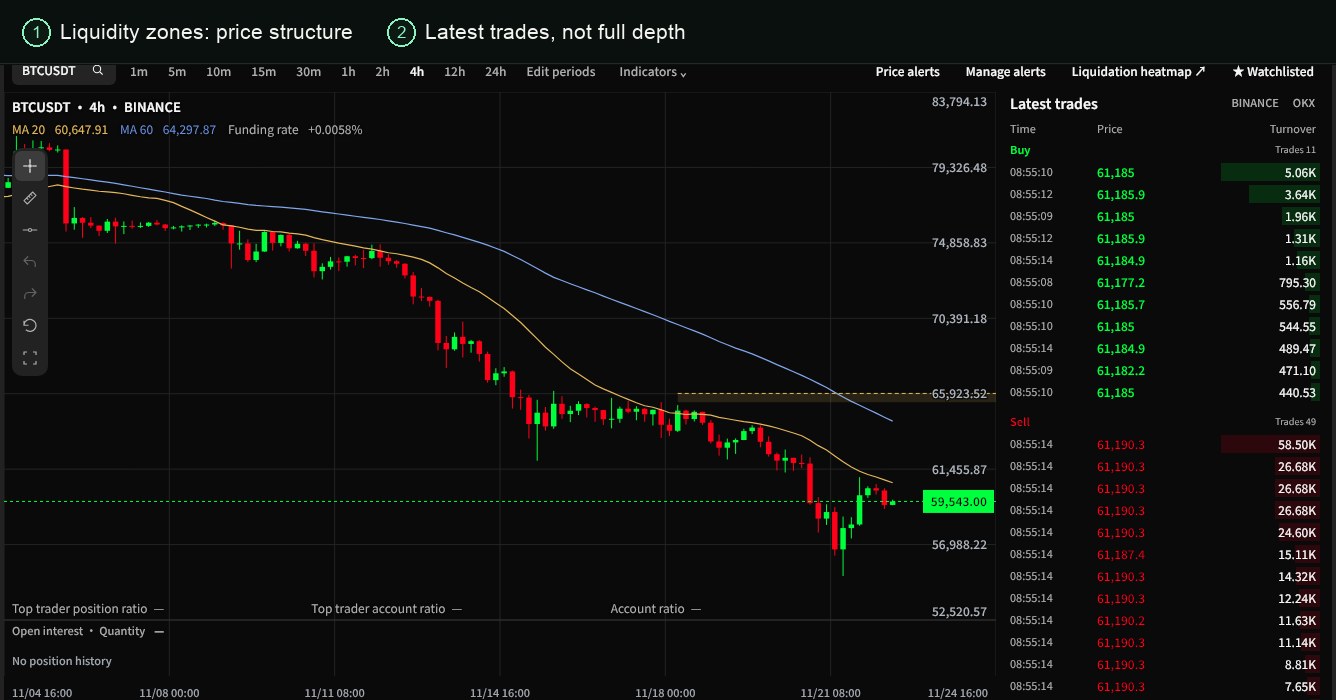
Recent trades show what actually traded, not what is available now. Use both: the book shows resting interest, and trades show where business was done.
03 / Change
Liquidity changes faster than a 24-hour chart suggests
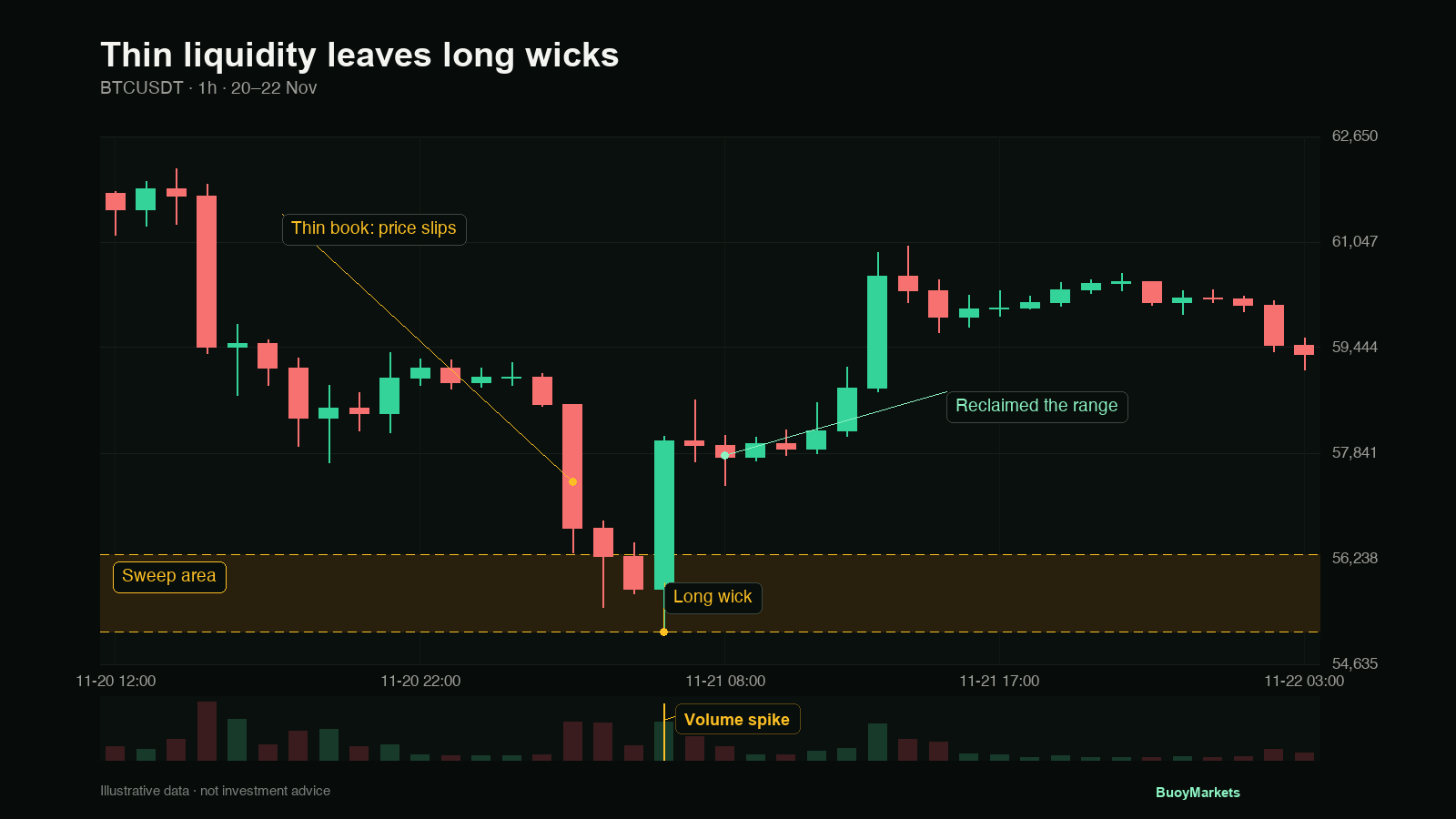
Liquidity is dynamic. It changes with the trading session, volatility, news and the behavior of market makers. A book that looks deep in a quiet hour can thin out in seconds.
Liquidation clusters and stop levels can add flow when price approaches them. That does not make them magnets or guarantees. They are conditional areas where a move may accelerate.
If you are trading size, check the book close to the time you act, not only at the start of the day.
04 / Practice
Size the order to the market
Compare venues before routing a large order. The same asset can have different depth on different exchanges, and aggregated depth is not a single order book.
Use limit orders when the book is thin, and avoid assuming that a stop will fill at the level you drew. In fast markets, the fill can be worse.
Open interest and funding describe positioning and the cost of holding a perpetual. They are not order book depth. Read them separately, then combine the picture.
05 / Buoy
How Buoy shows liquidity and trades
Buoy’s chart can draw price-structure liquidity zones, and the latest-trades panel lists recent buys and sells from Binance and OKX. The zones are inferred from swings, not order-book depth; the trade list shows what traded, not what is resting.
Use it to see whether a move is supported by trading activity. Combine it with price alerts and the support and resistance guide when you plan a level.
06 / FAQ
Common questions
Is high 24-hour volume always liquid?
No. Volume counts what traded; liquidity describes what can trade now at a reasonable price. A high-volume contract can still have a thin book during a quiet session.
What is slippage?
The difference between the price you expected and the average price you actually receive. It grows with order size and with thin liquidity.
What does a thin order book mean?
There are few resting orders near the mid price. A large order can move the price before it is filled.
Are liquidation levels guaranteed to be hit?
No. They are areas where forced flow may appear if price reaches them. They are conditional, not magnets.
Does liquidity predict direction?
No. It tells you the cost and constraints of trading, not where price will go.
Is this financial advice?
No. This guide is educational. Perpetual futures are leveraged and can lose more than your initial margin.
Perpetual futures are leveraged products. This guide is educational and is not financial advice. Use risk limits and do your own research.
Put it to work
Check the book before you size the order
Use the depth and latest-trade views to see what the market can absorb.