
01 / Definition
The best entry is a combination, not a price
The best entry is not the lowest price on the chart. It is the best combination of price, timing, liquidity and risk that you can actually execute.
No terminal can guarantee it. A repeatable process can stop three common mistakes: chasing a candle that has already left, entering without a level, and ignoring what a thin book will do to the fill.
Treat “best” as a process question: what would make this entry good, and what would prove it wrong?
02 / Context
Start with the market, not the coin
A good level in the wrong regime is a bad trade. Start with the higher-timeframe structure: is the market trending, ranging or transitioning?
- Find movementUse rankings to see which contracts are actually moving, with enough turnover to trade.
- Classify structureThe structure screener puts contracts into up, down, range, high and low. Do not force a trend where price is rotating.
- Check locationThe volatility radar shows how close price is to recent highs and lows. A level near the edge of a range is different from one in the middle.
Pick the contract before you fall in love with the setup. Liquidity and volatility are part of the entry decision, not an afterthought.
03 / Level
Wait for the level, not the excitement
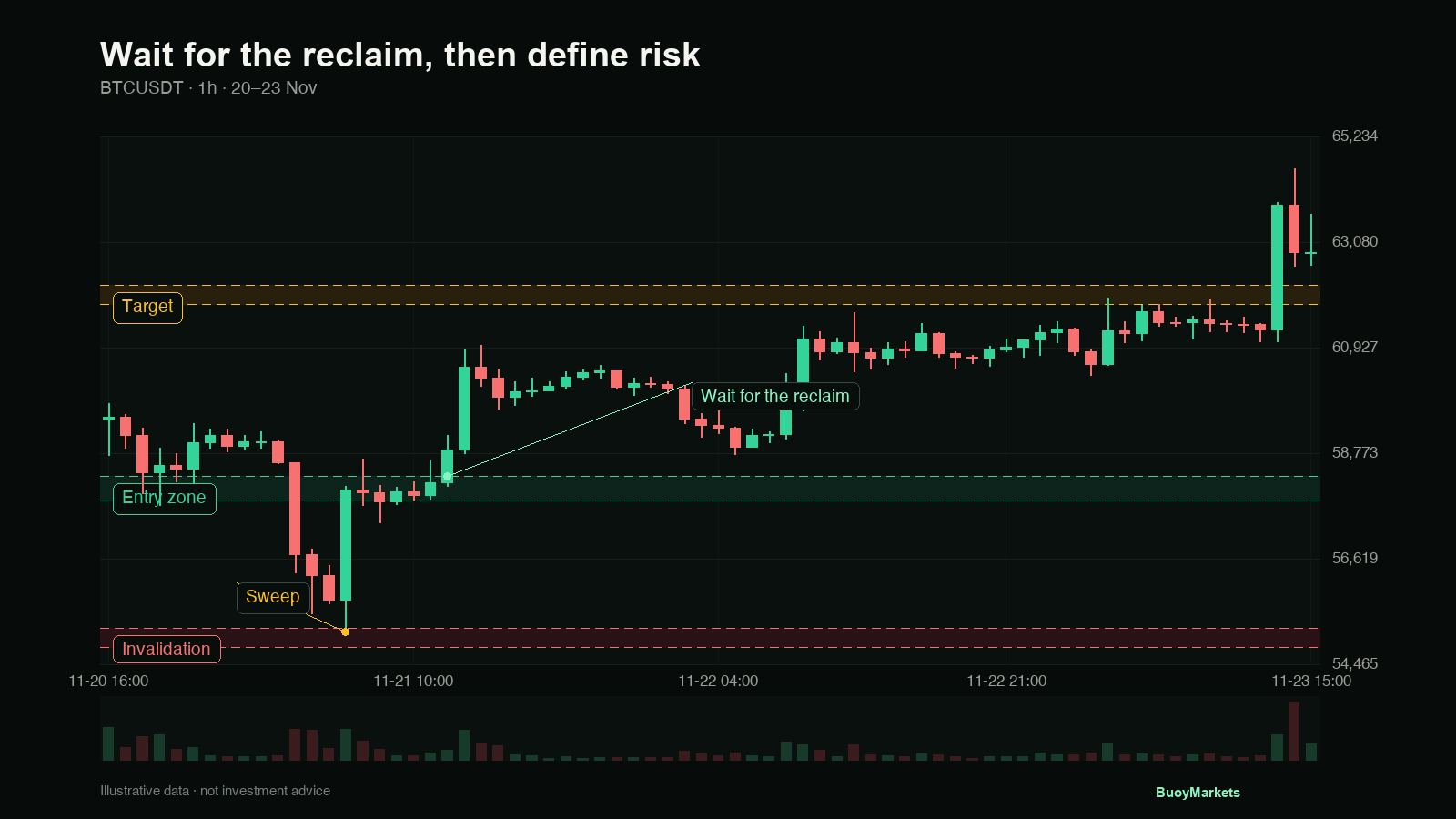
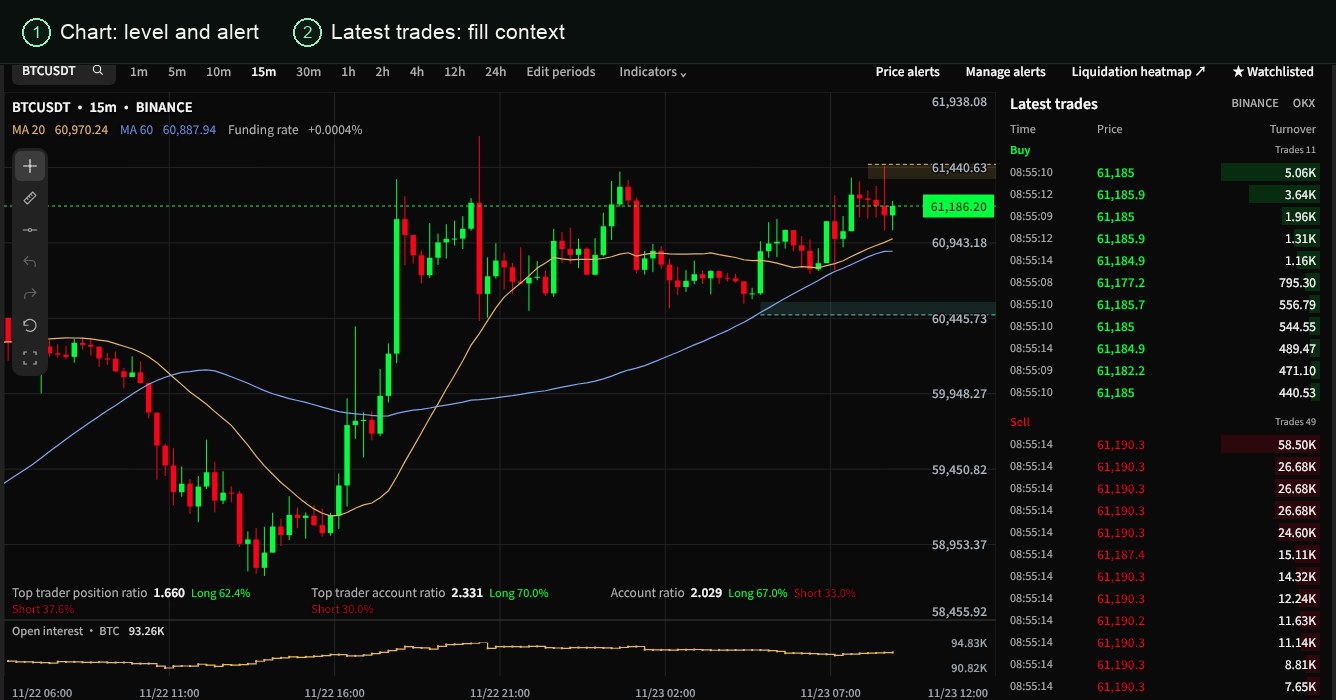
Mark the zone that would make the idea interesting, then set a price alert. Let the terminal watch the level instead of refreshing the chart every few minutes.
A touch is not confirmation. Look for a reaction: a rejection wick, a close back inside the range, or a reclaim that holds. The exact candle depends on your timeframe; the principle is the same.
If price has already left the zone, the entry is gone. A wider stop is not a better opportunity; it is a worse trade with the same idea.
04 / Execution
Check liquidity and participation before the order
The chart gives you a price; the market gives you a fill. Before sizing, check whether the move has participation and whether the book can absorb your order.
- Recent tradesIs the move supported by active buying or selling, or is it drifting on thin flow?
- Open interest and fundingAre positions being added or closed? Is one side paying to hold? These are context, not a standalone signal.
- Large-holder activitySmart-money and whale views can show positioning, but not intent.
- SlippageA thin book turns a good chart into a bad fill. Use limit orders when the market is thin.
05 / Risk
Define the exit before the entry
Before you place the order, write down the invalidation and the first target. If the distance to invalidation is too wide for the risk you can take, the entry is not ready.
- Higher timeframe contextTrend, range or transition; align the setup with it.
- Level and alertThe zone is marked and the alert is set.
- ReactionThe lower timeframe confirms; you are not buying a falling knife.
- Liquidity and participationThe fill is realistic and the move has activity.
- Invalidation and sizeThe risk is defined before the order, not after.
- ReviewLog what happened and which condition failed or held.
“Best execution” is a process, not a prediction. The goal is to make fewer avoidable mistakes.
06 / FAQ
Common questions
Can Buoy tell me the best entry?
No. Buoy provides structure, levels, liquidity context and alerts. The entry decision and the risk are yours.
Is a liquidity zone a buy or sell signal?
No. It is a price area inferred from structure. It becomes useful only with a reaction and a defined invalidation.
Should I use limit or market orders?
It depends on urgency and depth. A limit order controls the price but may not fill; a market order fills faster but can slip in a thin book.
Which timeframe should I use for the entry?
Match the timeframe to your holding period. A higher timeframe sets direction; a lower timeframe can time the reaction.
Does a liquidation sweep guarantee a reversal?
No. A sweep can mark exhaustion, but it can also continue. Wait for confirmation and define where the idea fails.
Is this financial advice?
No. This guide is educational. Perpetual futures are leveraged and can lose more than your initial margin.
Perpetual futures are leveraged products. This guide is educational and is not financial advice. Use risk limits and do your own research.
Put it to work
Turn the checklist into a routine
Open the chart, mark the level and let an alert do the waiting.